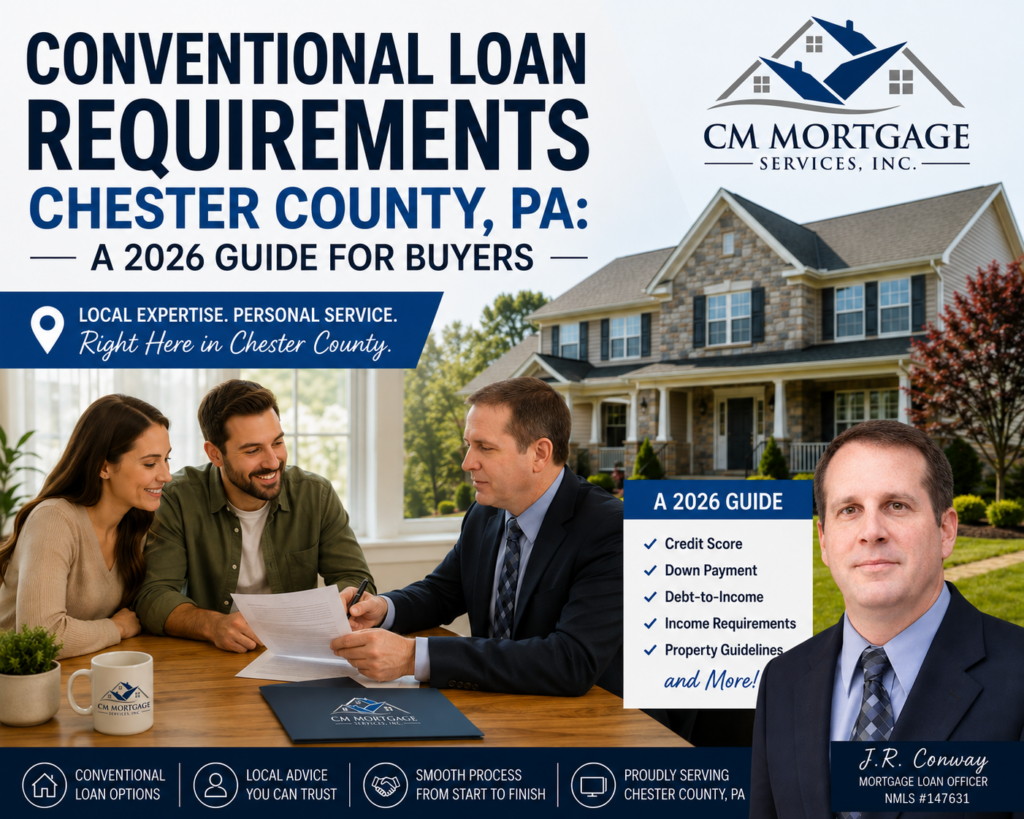
Conventional Loan Requirements Chester County PA: A 2026 Guide for Buyers
Conventional Loan Requirements Chester County PA: A 2026 Guide for Buyers
Conventional loan requirements in Chester County PA are more achievable than most buyers expect, and understanding them before you start your home search gives you a real competitive advantage in this market.
Chester County is not a market where you can figure out your financing on the fly. Homes in the $540,000 to $600,000 range are going under contract in under three weeks. Sellers consistently favor conventional offers over government-backed alternatives when they have a choice. Knowing whether you qualify for conventional financing, and what it takes to get there, is one of the most important things you can sort out before you ever attend an open house.
I am J.R. Conway, and I have been closing conventional loans across Chester County for over 20 years. This guide covers exactly what you need to qualify, how conventional loans work at current price points, and why this program dominates the local market.
What Is a Conventional Loan?
A conventional loan is any mortgage not backed by a federal government agency. FHA loans are backed by the Federal Housing Administration. VA loans are backed by the Department of Veterans Affairs. USDA loans are backed by the Department of Agriculture. Conventional loans are backed by nothing except the borrower’s creditworthiness and the lender’s underwriting standards.
Most conventional loans sold on the secondary market conform to guidelines set by Fannie Mae or Freddie Mac. These are called conforming loans. Loans that exceed the conforming loan limit are called jumbo loans and have their own, stricter requirements.
For Chester County buyers in 2026, the conforming loan limit for a single-family home is $832,750. Most purchase transactions in the county fall within this limit, which means conventional conforming financing is available to a large share of buyers here. For full details on current loan limits, the Federal Housing Finance Agency publishes updated limits at fhfa.gov.
Conventional Loan Requirements in Chester County PA: The Core Four
There are four things underwriters look at when evaluating a conventional loan application. Credit score. Debt-to-income ratio. Down payment and assets. Employment and income. Every file is judged on all four together, not any one in isolation.
Credit Score
The minimum credit score for most conventional loans is 620. That is the floor. But where your score actually sits has a significant impact on the rate you receive.
Conventional pricing is tier-based. A borrower at 620 qualifies, but pays more than a borrower at 680. A borrower at 720 gets meaningfully better pricing than one at 680. The best conventional rates typically go to borrowers at 760 and above.
Here is a practical way to think about it. In a market where Chester County home values are averaging $540,000 to $600,000, the difference between a 640 and a 760 credit score can translate to a rate that is a quarter to half a point higher, which compounds into tens of thousands of dollars over the life of a 30-year loan.
If your score is sitting between 600 and 620 right now, it is worth spending three to six months building it before applying rather than defaulting to an FHA loan just to move faster. In this market, the program you qualify for affects more than your payment. It affects whether your offer gets accepted.
Our credit score guide for Chester County buyers walks through exactly how scores affect your options and what moves the needle fastest.
Debt-to-Income Ratio
Your debt-to-income ratio, or DTI, is the percentage of your gross monthly income that goes toward monthly debt payments. It is calculated two ways.
Your front-end DTI is just your proposed housing payment, including principal, interest, taxes, insurance, and any HOA fees, divided by your gross monthly income.
Your back-end DTI is all of your monthly debt obligations, including the housing payment plus car loans, student loans, credit card minimums, and any other installment or revolving debt, divided by your gross monthly income.
For conventional loans, the standard maximum back-end DTI is 45%, though automated underwriting systems can approve files up to 50% in some cases when other factors are strong, such as high credit scores or significant reserves.
In practical terms: if you earn $10,000 per month before taxes, your total monthly debt load including your new mortgage generally needs to stay under $4,500 to qualify conventionally. Student loans, car payments, and credit card minimums all count. Understanding your DTI before you start shopping tells you exactly what purchase price range works for your situation.
Down Payment
The minimum down payment for a conventional loan depends on a few variables.
First-time buyers using Fannie Mae’s HomeReady or Freddie Mac’s Home Possible programs can put as little as 3% down. These programs have income limits but are genuinely useful for buyers who meet the criteria.
Repeat buyers, meaning buyers who have owned a home in the past three years, typically need at least 5% down on a conventional loan.
Jumbo loans, for purchases above $832,750, generally require 10% to 20% down depending on the lender and loan size.
Putting less than 20% down on a conventional loan triggers private mortgage insurance, or PMI. PMI is a monthly cost added to your payment that protects the lender if you default. The rate varies based on your credit score, down payment amount, and loan size, but for a Chester County purchase in the $550,000 range with 5% down, you are typically looking at $150 to $250 per month in PMI.
The key difference between PMI on a conventional loan and mortgage insurance on an FHA loan: conventional PMI can be cancelled once you reach 20% equity in the home. FHA mortgage insurance on loans with less than 10% down stays for the life of the loan. That long-term cost difference is one reason buyers who can qualify conventionally are usually better served by conventional financing over time.
Our down payment guide for Chester County covers the full breakdown by loan program and walks through closing cost estimates as well.
Employment and Income
Conventional loans require two years of employment history and verifiable income. The documentation requirements depend on how you earn your money.
W-2 employees are the most straightforward. Two years of W-2s, recent pay stubs covering the last 30 days, and two months of bank statements covering your down payment and reserves. If you have recently changed jobs but stayed in the same field, that typically does not create problems.
Self-employed borrowers need two years of personal and business federal tax returns, a current profit and loss statement, and business bank statements in many cases. The challenge for self-employed buyers is that tax returns often show less income than the business actually generates after legitimate deductions. If your tax returns significantly understate your real income, a bank statement loan program may actually be a better fit than conventional financing. We work through that comparison during the pre-approval conversation.
Bonus and commission income can be counted if it has been received for at least two years and is likely to continue. We use a two-year average.
Rental income from investment properties can sometimes be counted toward qualifying income depending on the situation, though the rules around this are specific and worth discussing before you assume it helps your file.
Conventional vs. FHA in the Chester County Market
I want to spend a moment on this because it is one of the most common conversations I have with buyers who are on the edge of qualifying conventionally.
From a pure qualification standpoint, FHA is easier. Lower minimum credit scores. More flexibility on DTI. Lower down payment for buyers with limited savings. If those are your constraints, FHA serves a real purpose.
But in Chester County’s competitive market, there is a meaningful cost to using FHA beyond just the mortgage insurance.
Sellers in this market prefer conventional offers. When a seller is reviewing multiple bids, an FHA offer carries more perceived risk. FHA appraisers are required to flag property condition issues, potential safety hazards, and items that need repair before the loan can close. Sellers do not want that contingency. In a situation where a seller is choosing between a conventional offer and an FHA offer at the same price, the conventional offer wins most of the time.
That dynamic is real. I see it regularly. So when a buyer is sitting at a 640 credit score with 5% down, I always have an honest conversation about whether the next three to six months building credit to a level where conventional is viable is worth it, versus moving forward with FHA and accepting the positioning disadvantage.
Sometimes FHA is the right answer. Sometimes the wait pays off. There is no universal answer, but it is a conversation worth having before you commit to a program.
Fannie Mae HomeReady and Freddie Mac Home Possible
These two programs deserve specific attention for Chester County first-time buyers and moderate-income buyers.
Both are conventional loan programs with down payments as low as 3%. Both have income limits, which vary by census tract and are tied to area median income. Both allow gift funds for the down payment and permit non-occupant co-borrowers in some cases.
HomeReady and Home Possible are not specialty programs for struggling buyers. They are smart, well-structured conventional products that allow buyers who meet the income criteria to access conventional financing with minimal cash down, avoid the long-term MIP trap of FHA, and compete with stronger offers in a multiple-bid situation.
If you are a first-time buyer or your household income falls within the program limits for your target area, it is worth checking whether HomeReady or Home Possible improves your positioning compared to a standard conventional or FHA approach.
What Conventional Financing Looks Like at Chester County Price Points
Let me run through a few practical examples at current market prices.
Purchase price: $549,000 (near Chester County median) Down payment at 5%: $27,450 Loan amount: $521,550 This sits well within the conforming limit. A buyer at 720 credit and 45% DTI qualifies cleanly for conventional financing. PMI applies but can be removed once equity reaches 20%.
Purchase price: $700,000 (West Chester Borough range) Down payment at 10%: $70,000 Loan amount: $630,000 Still within conforming limits. Reserves become more important at this price point. Lenders want to see two to six months of housing payment in savings after closing.
Purchase price: $875,000 (higher-end townships and borough) Down payment at 10%: $87,500 Loan amount: $787,500 Within conforming limits at this down payment level. Reserves and credit score quality become increasingly important as the loan amount grows.
Purchase price: $950,000 Down payment at 20%: $190,000 Loan amount: $760,000 Also within conforming at 20% down. At this price point, reserves, credit score, and documentation quality matter significantly.
The Role of Reserves
One requirement that surprises buyers is the reserve requirement. Reserves are liquid assets you have in savings or investment accounts after your down payment and closing costs are paid.
For conventional loans, lenders typically want to see two months of housing payment in reserves after closing. At higher loan amounts, stronger underwriting risk factors, or investment property purchases, that requirement goes up.
Reserves do not have to be cash in a checking account. They can include savings accounts, money market funds, retirement accounts in some cases, and investment portfolios. The specifics depend on the lender and program. But the core point is this: your cash does not end at the down payment. You need to demonstrate financial stability after you close.
Conventional Loans for Investment Properties in Chester County
DSCR and bank statement loans get a lot of attention in the investor world, and for good reason. But conventional financing is also available for investment property purchases, including single-family rentals, duplexes, triplexes, and fourplexes.
Conventional investment property loans require a minimum of 15% to 25% down depending on property type and typically have stricter credit and reserve requirements than primary residence loans. The rates carry an adjustment above primary residence pricing. But for investors with clean W-2 income and strong credit, conventional investment loans can offer competitive terms compared to DSCR alternatives.
If you are considering an investment purchase in Chester County, the program comparison is worth doing before you commit to a direction.
Getting Pre-Approved for a Conventional Loan in Chester County
The pre-approval process for a conventional loan is more thorough than a basic pre-qualification. Here is what we typically need to get you a real approval letter.
Recent pay stubs covering the last 30 days. W-2s and federal tax returns for the past two years. Bank and investment account statements for the past two to three months. A government-issued ID. For self-employed borrowers, business tax returns and a current profit and loss statement.
With a complete documentation package, I can typically have a pre-approval letter ready within one business day. In Chester County’s market, speed matters. Sellers are not waiting around for buyers to get their paperwork organized.
For a full walkthrough of the pre-approval process, see our Chester County mortgage pre-approval guide.
Frequently Asked Questions: Conventional Loans Chester County PA
What credit score do I need for a conventional loan in Chester County PA?
The minimum is 620 for most conventional programs. However, the best rates and terms go to borrowers with scores of 720 and above. If your score is between 600 and 620, a short period of credit building before applying can make a meaningful difference in both your rate and your offer competitiveness.
What is the minimum down payment for a conventional loan?
Three percent for first-time buyers using HomeReady or Home Possible. Five percent for most repeat buyers. Twenty percent eliminates PMI entirely. Jumbo loans typically require 10% to 20% depending on loan size and lender.
What is the conforming loan limit for Chester County in 2026?
$832,750 for a single-family home. Purchases above that amount require jumbo financing with different underwriting standards.
How is conventional different from FHA in Chester County?
Conventional requires stronger credit and a slightly larger down payment in some cases, but offers better positioning in competitive offer situations, no mandatory property condition checklists for appraisers, and mortgage insurance that can be cancelled once you reach 20% equity. FHA mortgage insurance on loans with less than 10% down stays for the life of the loan.
Can I use gift funds for a conventional down payment?
Yes. Gift funds from family members are acceptable for conventional loans with proper documentation. The gift letter needs to confirm no repayment is expected.
Does my student loan debt count against me on a conventional loan?
Yes. Student loan payments are included in your debt-to-income calculation. If your loans are in deferment, conventional guidelines typically count a percentage of the outstanding balance as a monthly payment. We work through this during the pre-approval so there are no surprises.
Can I get a conventional loan if I am self-employed?
Yes, with two years of tax returns showing sufficient income. If your returns understate your real earnings due to business deductions, a bank statement loan program may be worth comparing to a conventional approach.
What happens if the home I want to buy does not appraise?
If the appraised value comes in below the purchase price, you have several options: renegotiate the price with the seller, cover the gap in cash, or walk away if your contract includes an appraisal contingency. Conventional loans give you more flexibility in this situation than government-backed loans because there is no government appraisal checklist creating additional friction.
Work with a Local Chester County Conventional Loan Expert
J.R. Conway (NMLS #147631) is the owner and VP of CM Mortgage Services Inc., a second-generation, family-owned mortgage brokerage located at 1240 West Chester Pike, Suite 212, West Chester, PA 19382. Founded in 1985, our company has been helping Chester County buyers navigate home financing for over 20 years. We offer Conventional, FHA, VA, USDA, Jumbo, DSCR, bank statement, and renovation loan programs.
As a mortgage broker, I shop your file across multiple lenders to find the most competitive conventional pricing for your credit profile and purchase price. You are not locked into one bank’s rate sheet. You get the market working for you.
Learn more about how conventional financing works in this market on our conventional loans Chester County PA page.
All loans subject to credit approval. Equal Housing Lender. CM Mortgage Services Inc. NMLS #147631. Not a commitment to lend.


