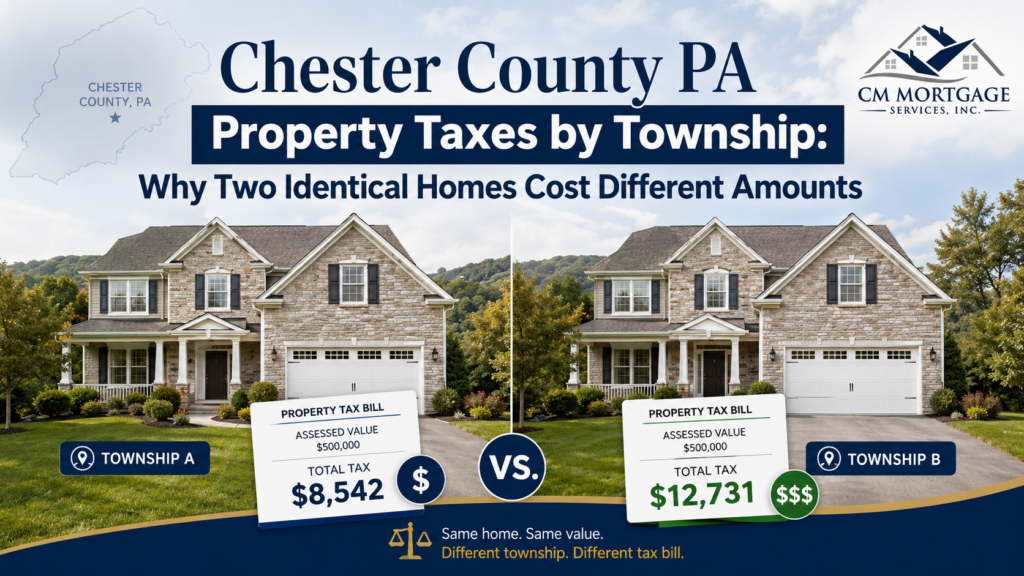
Chester County PA Property Taxes by Township: Why Two Identical Homes Cost Different Amounts
Chester County PA Property Taxes by Township: Why Two Identical Homes Cost Different Amounts
I say some version of this in almost every conversation I have with a Chester County buyer. Two homes with the same price can carry monthly payments that differ by hundreds of dollars, and the reason is property taxes that change from one township to the next.
Buyers nod along, but I am not sure most of them believe how big the difference actually is until they see it in numbers. So this post is the numbers. This is the explainer I wish every Chester County buyer read before they started touring homes, because understanding how property tax works here changes which houses you should even be looking at.
I am J.R. Conway, owner and VP of CM Mortgage Services Inc., a second generation, family owned mortgage brokerage at 1240 West Chester Pike in West Chester. I have been financing homes across Chester County for over 20 years, and property tax is the single most overlooked factor in what a home actually costs to own here. Let me walk you through how it works, why it varies so much, and what it means for your monthly payment.
The Three Layers of Your Chester County Property Tax Bill
Your property tax bill in Chester County is not one tax. It is three separate taxes from three independent authorities, added together.
The county tax is the same for every property in Chester County. The 2026 Chester County millage rate is 5.164 mills. A mill is one dollar of tax for every one thousand dollars of assessed value. This layer does not vary by location, so it is the simple part.
The municipal tax is set independently by each township and borough. This is where the variation begins. Some Chester County townships charge under one mill. Others charge several mills. Each municipality sets its own rate every year based on its own budget, so two neighboring townships can have meaningfully different municipal rates.
The school district tax is the big one. It is by far the largest component of your property tax bill, and it varies the most across the county. School district millage rates in Chester County range from roughly 23 mills at the low end to roughly 44 mills at the high end. That is nearly a two to one difference depending on which district a home sits in.
Add those three layers together and you get your combined millage rate, which is what actually determines your annual tax bill. Because the county layer is fixed and the municipal layer is relatively small, the school district is what drives most of the difference between one home’s tax bill and another’s.
Why the School District Layer Varies So Much
Chester County has the highest median school taxes of any county in Pennsylvania, at roughly $5,386 according to a recent report, ahead of Montgomery, Delaware, and Bucks. That is not a knock on the county. It is the direct reason Chester County’s public schools are among the best in the state. School districts in Pennsylvania are funded primarily through local property taxes, so strong, well funded districts carry higher millage, and that higher millage shows up in your monthly mortgage payment.
Here is a sample of 2026 school district millage rates across the county to show the range:
- West Chester Area School District: roughly 23.38 mills, among the lowest in the county
- Great Valley School District: roughly 25.22 mills
- Downingtown Area School District: roughly 31.91 mills
- Kennett Consolidated School District: roughly 34.99 mills
- Avon Grove School District: roughly 36.00 mills
- Owen J. Roberts School District: roughly 36.36 mills
- Oxford Area School District: roughly 38.44 mills
- Octorara Area School District: roughly 43.46 mills
- Coatesville Area School District: roughly 44.36 mills
Look at that spread. A home in the West Chester Area School District carries a school tax rate of about 23 mills. A home in the Coatesville Area School District carries about 44 mills. That is nearly double, on the largest component of the bill, before you even factor in the municipal layer.
This produces a result that surprises a lot of buyers. Some of the county’s most desirable, highest priced areas sit in school districts with relatively low millage, while some of the most affordable purchase prices sit in districts with the highest millage. The West Chester Area School District has both premium home values and one of the lowest millage rates in the county. It is a reminder that a low tax rate and a low purchase price do not go together in Chester County.
What This Actually Means for Your Monthly Payment
Let me put real numbers on it, because this is where it becomes concrete.
Chester County uses an assessment ratio, meaning your tax is calculated on an assessed value rather than directly on the market price. Assessments and the Common Level Ratio that bridges them to current market value are their own topic, and the exact math depends on the specific property’s assessment. But the practical effect of the combined millage difference is easy to illustrate.
Take two homes, both priced at $550,000.
The first sits in a township and school district with a combined millage around 40 mills. Its annual property tax works out to roughly $8,800.
The second sits in a township and school district with a combined millage around 50 mills. Its annual property tax works out to roughly $11,000.
That is a difference of about $2,200 a year on two homes at the exact same price. Spread across twelve monthly mortgage payments, that is roughly $183 a month, every month, for as long as you own the home.
Now think about what $183 a month does to your qualifying picture. When I calculate what you can afford, your property tax is part of your monthly housing payment, which is part of your debt to income ratio. A higher tax bill on the same purchase price means a higher monthly payment, which means you qualify for less house. Two buyers with identical incomes and identical down payments can qualify for different purchase prices depending on which township they are shopping in.
This is not a rounding error. It is one of the most important numbers in your entire home search, and it is invisible in a listing price.
Why a National Lender Cannot Get This Right
Here is the part that matters for how you choose who finances your home.
When you apply with a national online lender, your estimated monthly payment is built off a property tax figure that comes from a database, often a county average or a rough estimate. That estimate does not know that the specific home you are buying sits in Coatesville Area School District at 44 mills rather than West Chester Area at 23 mills. So the payment estimate you get at application can be meaningfully wrong, and you find out at the closing table when the escrow number is higher than you planned.
I have been closing loans in these specific townships for over 20 years. When I build a payment estimate for a Chester County buyer, I pull the actual millage for the specific parcel: the county rate, the municipal rate for that exact township, and the school district rate for that exact district. The number I give you is the number you will actually pay. That is not a marketing claim. It is just the difference between local knowledge and a national database, and in a county with this much township variation, it is a difference that shows up in real dollars.
How to Use This Before You Start Shopping
The practical takeaway is simple. Do not fall in love with a house before you know its actual tax bill.
Before you tour homes, have a conversation about your target price range and the townships you are considering, and let me show you what the combined millage does to the monthly payment in each. Sometimes a buyer discovers they can afford a higher purchase price in a low millage township than they can in a high millage one, for the same monthly payment. That insight changes the entire search.
When you find a specific home, get the property specific tax number before you write the offer, not after. The listing may show last year’s tax, or a figure based on a prior assessment, or nothing at all. Knowing the real annual tax for that parcel, and what it does to your all in monthly payment, is part of writing an informed offer.
And factor the tax difference into your community comparison. When you are weighing a home in one part of the county against a home in another, the purchase prices are only part of the story. The combined millage can tilt the real cost of ownership in a direction the sticker prices do not reveal.
For how school districts affect home values across the county, see our Chester County School Districts and Home Values guide. For the full pre approval process where we build these property specific numbers together, see our Mortgage Pre-Approval Chester County PA guide. For how much house your income supports at different price points, see our How Much Income to Buy a Home Chester County PA guide. And for what makes working with a local broker different, see our guide on what working with a local Chester County mortgage broker actually looks like.
A Note on the Homestead Exclusion and Senior Relief
Two things worth knowing that can reduce your bill.
Pennsylvania’s Homestead Exclusion, established under Act 1 of 2006, is state funded and reduces the assessed value used to calculate your school tax on your primary residence. Each school district allocates its share of the state’s Property Tax Reduction Allocation, and the typical reduction runs somewhere in the range of a few hundred dollars per year. You apply for it through the county, and it only applies to your primary residence, not investment or second homes.
Pennsylvania also offers a Property Tax and Rent Rebate program for income qualified seniors and certain disabled residents, which can provide additional relief. If you or a family member buying in Chester County is a senior on a fixed income, it is worth looking into.
Neither of these changes the township to township variation that this post is about, but both can take some of the edge off the bill for eligible homeowners.
Frequently Asked Questions: Chester County PA Property Taxes by Township
Why do two homes at the same price have different property taxes in Chester County?
Because property tax is set by three independent layers: the county, the municipality, and the school district. The county rate is the same everywhere at 5.164 mills for 2026, but municipal and especially school district rates vary significantly by location. School district millage in Chester County ranges from roughly 23 to 44 mills. Two homes at the same price in different townships and districts can carry annual tax bills that differ by $2,000 or more.
Which Chester County school district has the lowest property taxes?
The West Chester Area School District has one of the lowest school district millage rates in the county at roughly 23.38 mills for 2026, despite serving some of the county’s most desirable and highest priced areas. This is a good example of why a low tax rate and a low purchase price do not go together in Chester County.
Which Chester County school district has the highest property taxes?
The Coatesville Area School District carries one of the highest school district millage rates at roughly 44.36 mills for 2026, with Octorara Area close behind at roughly 43.46 mills. These higher rates apply in some of the more affordable purchase price areas of the county, which surprises buyers who assume lower prices mean lower taxes.
How much can property tax differences affect my monthly mortgage payment?
Significantly. On two homes both priced at $550,000, a combined millage difference of roughly 10 mills translates to about $2,200 a year, or roughly $183 a month. That difference is part of your monthly housing payment and your debt to income ratio, which means it can also change how much house you qualify for. Two buyers with identical finances can qualify for different purchase prices depending on the township.
How do I find the actual property tax on a specific Chester County home?
The accurate figure combines the county millage, the specific municipality’s millage, and the specific school district’s millage applied to the property’s assessed value. Listing figures are often outdated or based on prior assessments. When I work with a buyer, I pull the property specific tax for the exact parcel so the monthly payment estimate reflects what you will actually pay, rather than a county average that could be off by hundreds of dollars a month.
What is the Homestead Exclusion in Chester County?
The Homestead Exclusion is a state funded program under Act 1 of 2006 that reduces the assessed value used to calculate your school property tax on your primary residence. The reduction is typically a few hundred dollars per year and is allocated by each school district. You apply through the county, and it applies only to your primary residence.
Ready to Know What a Home Will Actually Cost You?
J.R. Conway is the owner and VP of CM Mortgage Services Inc., a licensed, second generation, family owned, veteran owned mortgage brokerage located at 1240 West Chester Pike, Suite 212, West Chester, PA 19382. NMLS #147631. CM Mortgage Services has been helping Chester County buyers finance homes for over 20 years, offering Conventional, FHA, VA, USDA, Jumbo, DSCR, bank statement, and renovation loan programs.
If you want to know what a specific Chester County home will actually cost you every month, taxes included, before you write an offer, that is exactly the conversation I have with every buyer. Start at cmmortgage.com or call 610-430-6852.
All loans subject to approval. Equal Housing Lender.


