Fixed vs Adjustable Rate Mortgage Chester County PA | 2026 Guide
One of the first decisions every Chester County homebuyer faces is choosing between a fixed rate and an adjustable rate mortgage. It sounds like a simple choice but the right answer depends entirely on your situation how long you plan to stay in the home, what rates are doing, what your financial goals are, and how much payment risk you are comfortable with.
I have been helping Chester County buyers make this decision for over 20 years. This guide explains exactly how each option works, what the real trade-offs are in 2026's rate environment, and how to think through which choice makes the most sense for your specific situation.
CM Mortgage Services Inc. is a licensed mortgage broker located at 1240 West Chester Pike, West Chester, PA 19382. J.R. Conway (NMLS #147631) has over 20 years of experience helping buyers finance homes across Chester County and the greater Philadelphia area. The company offers fixed rate and adjustable rate options across Conventional, FHA, VA, USDA, Jumbo, and bank statement loan programs. CM Mortgage Services is a second-generation, family-owned business focused on personalized service from pre-approval through closing.
Get a Rate Comparison — Free, No Obligation →
The Fixed Rate Mortgage — Payment Stability for the Life of the Loan
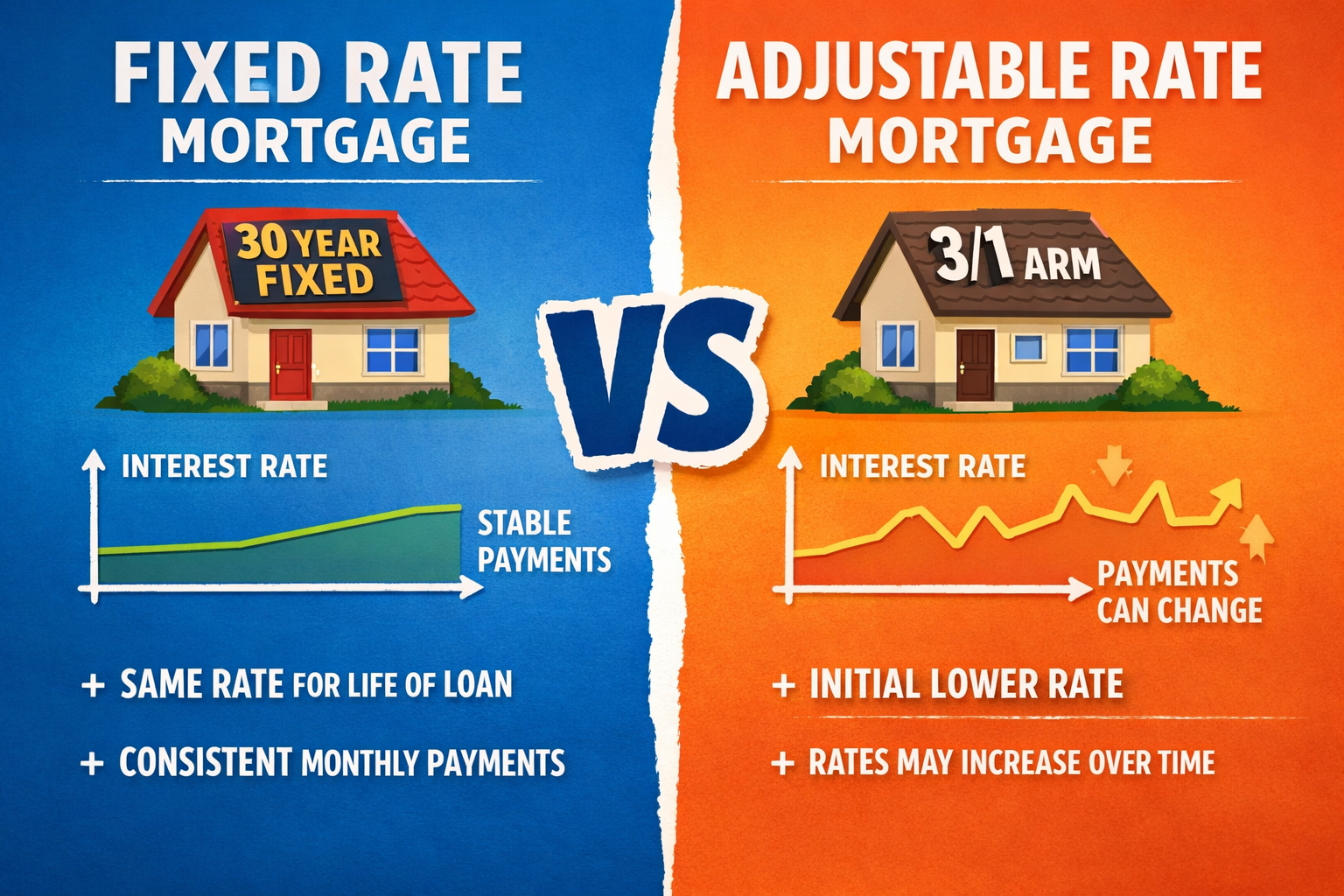
A fixed rate mortgage locks your interest rate at closing and keeps it there for the entire loan term. Your principal and interest payment is the same on day one as it is on the last payment 15 or 30 years later.
Rates go up after you close your payment stays the same. Rates go down your payment stays the same unless you refinance. Nothing changes. That predictability is the core value of a fixed rate mortgage.
The 30-Year Fixed
The 30-year fixed rate mortgage is the most commonly used mortgage in the United States and the most popular choice for Chester County buyers. Spreading the loan over 360 payments keeps the monthly obligation lower than any other fixed option, maximizes your purchasing power at a given income level, and preserves cash flow flexibility.
In Chester County where homes frequently range from $350,000 in Coatesville to over $900,000 in Chadds Ford, that payment flexibility matters. Most buyers choose the 30-year fixed because it gives them the room to qualify for the home they want while keeping enough monthly budget for everything else in their lives.
Who it works best for: First-time buyers, move-up buyers making a long-term commitment, buyers who want to maximize their loan amount relative to income, and anyone who values payment certainty over the life of the loan.
The 15-Year Fixed
The 15-year fixed offers a lower interest rate than the 30-year typically 0.5 to 0.75 percent lower in most market conditions in exchange for a higher monthly payment. The trade-off is significant on both sides.
The payment is noticeably higher. On a $500,000 loan the monthly principal and interest on a 30-year fixed at 6.5 percent is approximately $3,160. On a 15-year fixed at 5.75 percent it is approximately $4,160. That is $1,000 more per month.
The long-term savings are dramatic. The 30-year borrower pays approximately $638,000 in total interest. The 15-year borrower pays approximately $249,000. That is nearly $400,000 in savings over the life of the loan. Equity builds at roughly double the pace.
Who it works best for: Move-up buyers with strong household income who can handle the higher payment comfortably, buyers approaching retirement who want to own the home outright before they stop working, and buyers who are focused on minimizing total interest cost and maximizing long-term equity.
Other Fixed Rate Terms
Fixed rate mortgages are also available in 10-year, 20-year, and 25-year terms depending on the lender and loan program. These are less common but worth discussing for buyers whose specific situation calls for a term that does not fit the standard 15 or 30-year options.
For more detail on fixed rate options visit our fixed rate mortgage page.
The Adjustable Rate Mortgage — Lower Initial Rate With Future Uncertainty
An adjustable rate mortgage, or ARM, has an interest rate that changes after an initial fixed period. The rate is typically lower than a comparable fixed rate during the initial period which is the appeal, but it can move up or down after that period based on a market index.
Most ARMs available today are actually hybrid ARMs, meaning they have a fixed rate for an initial period and then adjust periodically after that. A pure ARM that adjusts from day one is rare in today's market.
How ARM Names Work
ARM products are named for their initial fixed period and adjustment frequency. A 5/1 ARM has a fixed rate for 5 years and adjusts every 1 year after that. A 7/6 ARM has a fixed rate for 7 years and adjusts every 6 months after that. The most common ARM products for Chester County buyers are the 5/1, 7/1, 7/6, and 10/1.
Here is how to read the name:
First number — How many years the rate is fixed at the start. Second number — How often the rate adjusts after the fixed period, in years or months.
A 7/6 ARM has a fixed rate for 7 years and adjusts every 6 months after that.
ARM Caps — How Much the Rate Can Move
ARM products have built-in caps that limit how much the rate can change at each adjustment and over the life of the loan. These caps are expressed as three numbers — for example 2/2/5.
First cap — Maximum rate increase at the first adjustment. A 2 means the rate cannot jump more than 2 percent at the initial adjustment.
Second cap — Maximum rate increase at each subsequent adjustment. A 2 means the rate cannot move more than 2 percent at any single adjustment after the first.
Lifetime cap — Maximum total rate increase over the life of the loan. A 5 means the rate can never be more than 5 percent above your initial rate regardless of what the market does.
On a 7/1 ARM starting at 5.75 percent with 2/2/5 caps, the rate can never exceed 10.75 percent over the life of the loan. Understanding your caps is essential before choosing an ARM.
The Index and the Margin
After the fixed period your ARM rate adjusts based on a market index. Most modern ARMs use the Secured Overnight Financing Rate, or SOFR, as their index. The new rate is calculated by adding a fixed margin typically 2.5 to 3.5 percent to the current index rate at the time of adjustment.
If SOFR is at 4.0 percent and your margin is 2.75 percent your new rate would be 6.75 percent, subject to caps. If SOFR falls to 2.0 percent your new rate would be 4.75 percent. The rate moves with the market within the cap structure.
Fixed vs ARM in Chester County's 2026 Market
This is the question I get consistently in 2026 and it deserves an honest answer rather than a default recommendation.
The Case for Fixed in Chester County Right Now
Chester County buyers are making long-term commitments. A home in West Chester, Downingtown, or Malvern is not a short-term trade. Most buyers plan to stay in their homes for five, ten, or twenty years. For a buyer with a long time horizon the certainty of a fixed rate is genuinely valuable you know your payment will never change regardless of what happens to rates over the next three decades.
Rates in 2026 are in the high 5 to low 6 percent range meaningfully lower than the peak rates of 2022 and 2023. For buyers who locked in at 7 percent or above a refinance into a lower fixed rate may be worth exploring. For new buyers the current fixed rate environment is more reasonable than it was two years ago.
For most Chester County buyers making long-term primary residence purchases, the 30-year fixed rate is the right foundation. The payment is predictable. The risk is minimal. The competitive position in a purchase offer is strong.
The Case for an ARM in Chester County
An ARM makes the most financial sense in specific situations that apply to a meaningful number of Chester County buyers.
You have a defined short-to-medium term horizon. If you know with reasonable confidence that you will sell or refinance within 5 to 7 years because of a planned job change, a growing family that will require a larger home, or other life circumstances the lower initial rate on a 7/1 ARM delivers real monthly savings during the period you will actually hold the loan. If the fixed rate is 6.5 percent and the 7/1 ARM is 5.75 percent, that 0.75 percent difference on a $600,000 loan saves approximately $375 per month for 7 years nearly $31,500 in total interest before you sell.
You are purchasing at a higher price point. At jumbo loan amounts the rate difference between fixed and ARM products can be more pronounced. A 0.75 percent rate difference on a $900,000 loan saves approximately $563 per month. For buyers in West Chester, Chadds Ford, Malvern, or Paoli where jumbo financing is common, the ARM calculation deserves serious attention when the time horizon fits.
You plan to refinance before the adjustment period. Some buyers choose an ARM specifically planning to refinance into a fixed rate before the adjustment kicks in betting that rates will be lower when they refinance than they are today. This is a legitimate strategy but it carries rate risk if rates do not fall as expected.
You have a clear financial plan that benefits from lower initial payments. Some buyers are in a transitional income phase early career, post-business sale, early in a career ramp where the lower initial payment of an ARM creates cash flow benefits that align with their financial situation for the initial period.
Comparing Fixed and ARM Options Side by Side
Here is a realistic comparison using a $600,000 loan amount at current 2026 rate levels. These are illustrative figures — actual rates change daily.
| 30-Year Fixed | 15-Year Fixed | 7/1 ARM | 5/1 ARM | |
|---|---|---|---|---|
| Initial Rate | 6.50% | 5.75% | 5.75% | 5.50% |
| Monthly P&I | $3,792 | $4,990 | $3,502 | $3,407 |
| Payment vs 30-Fixed | — | $1,198 more | $290 less | $385 less |
| Rate After Fixed Period | Stays 6.50% | Stays 5.75% | Adjusts | Adjusts |
| Risk After Fixed Period | None | None | Rate can rise | Rate can rise |
| Best For | Long-term stability | Fast payoff | 5-7 year horizon | Under 5 year horizon |
The monthly savings from an ARM versus the 30-year fixed are real $290 to $385 per month in this example. Over 7 years that is $24,360 to $32,340 in payment savings before adjustment. Whether that savings justifies the rate risk after the fixed period depends entirely on your specific timeline and financial situation.
Chester County Market Context — Which Term Fits Which Community
Different Chester County communities tend to attract different buyer profiles which influences the fixed versus ARM decision.
West Chester, Malvern, Paoli, Chadds Ford, Glen Mills — Higher-priced markets with jumbo loan amounts where the ARM rate advantage is largest in absolute dollars. Buyers at these price points who have a defined medium-term horizon should run the ARM calculation carefully. Explore our West Chester, Malvern, Paoli, Chadds Ford, and Glen Mills guides.
Downingtown, Exton, Phoenixville, Chester Springs — School-district driven buyers making long-term family commitments. The 30-year fixed is almost always the right answer here because the time horizon is long and payment certainty has real value for families budgeting over a decade or more. Explore our Downingtown, Exton, Phoenixville, and Chester Springs guides.
Coatesville, Oxford, West Grove, Avondale — More accessible price points where the monthly difference between fixed and ARM is smaller in absolute dollars. The 30-year fixed typically makes the most sense here for first-time buyers and buyers making a long-term commitment to southern Chester County. Explore our Coatesville, Oxford, West Grove, and Avondale guides.
For a full overview of all Chester County communities visit our Chester County mortgage guide.
How to Make the Decision
When a Chester County buyer asks me fixed or ARM, here are the questions I ask before giving an answer.
How long do you plan to stay in this home? If the honest answer is more than 7 years, fixed rate almost always wins on a risk-adjusted basis. If the honest answer is 5 to 7 years the ARM calculation is worth running carefully. Under 5 years the ARM is worth serious consideration.
What is the rate difference between the fixed and the ARM you are considering? If the rate difference is 0.25 percent the ARM savings are minimal and the risk is not worth it. If the difference is 0.75 to 1.0 percent or more the savings are meaningful and the decision deserves careful analysis.
Can you absorb a payment increase if the ARM adjusts upward? The caps protect you from catastrophic increases but a 2 percent rate jump at first adjustment is still real money. On a $500,000 loan that is approximately $625 more per month. Can your budget handle that if it happens?
Are you planning to refinance before the adjustment? If so what rate environment are you betting on? If rates are the same or higher when your ARM adjusts your plan needs adjustment too.
Is this a primary residence or an investment property? Investors with defined exit timelines or specific cash flow requirements sometimes have clear reasons to favor ARMs. Primary residence buyers with family stability and long time horizons usually favor the certainty of fixed.
I run both calculations side by side for every buyer who asks this question so the decision is grounded in your real numbers rather than a general rule.
Frequently Asked Questions
What is the difference between a fixed rate and adjustable rate mortgage? A fixed rate mortgage locks your interest rate for the entire loan term your payment never changes. An adjustable rate mortgage has a fixed rate for an initial period and then adjusts periodically based on a market index. Fixed rates offer certainty. ARMs offer a lower initial rate with future rate risk.
What is a hybrid ARM and how does it work? A hybrid ARM also called a fixed-period ARM has a fixed interest rate for an initial period, typically 5, 7, or 10 years, and then adjusts periodically after that based on a market index plus a fixed margin. Most ARM products in today's market are hybrid ARMs. The name tells you the structure a 7/1 ARM is fixed for 7 years and adjusts every 1 year after that.
Is a fixed or adjustable rate better for Chester County buyers in 2026? For most Chester County buyers making long-term primary residence purchases, the 30-year fixed rate is the right choice. The time horizon is typically long, payment certainty is valuable, and the competitive position in a purchase offer is strong. For buyers with a defined 5 to 7 year horizon especially at higher loan amounts where the rate difference is meaningful an ARM calculation is worth running carefully.
What are ARM caps and why do they matter? ARM caps limit how much your rate can change at each adjustment and over the life of the loan. A typical cap structure expressed as 2/2/5 means the rate can increase no more than 2 percent at the first adjustment, no more than 2 percent at each subsequent adjustment, and no more than 5 percent total over the life of the loan. Understanding your caps before choosing an ARM is essential for knowing your worst-case payment scenario.
Can I refinance out of an ARM into a fixed rate? Yes. Refinancing from an ARM into a fixed rate is common, especially before the initial fixed period ends. Many buyers choose an ARM planning to refinance before the first adjustment. This strategy carries rate risk if rates are higher when you refinance than when you originally closed you may pay more than you saved during the ARM's initial period.
Which ARM term is most common for Chester County buyers? The 7/1 ARM is most commonly used for Chester County buyers who are considering an adjustable option. It provides 7 years of payment certainty — long enough for most medium-term plans while delivering the rate advantage of an ARM. The 5/1 ARM is also used for buyers with shorter defined horizons.
You can review general mortgage product information through the Consumer Financial Protection Bureau.
About CM Mortgage Services Inc.
CM Mortgage Services Inc. is a licensed mortgage broker located at 1240 West Chester Pike, West Chester, PA 19382. J.R. Conway (NMLS #147631) has over 20 years of experience helping buyers choose the right rate structure for their specific situation across Chester County and the greater Philadelphia area. The company offers fixed rate and adjustable rate options across Conventional, FHA, VA, USDA, Jumbo, and bank statement loan programs. CM Mortgage Services is a second-generation, family-owned business focused on personalized service from pre-approval through closing. We run the fixed versus ARM comparison specifically for your loan amount, your timeline, and current rates so the decision is grounded in your actual numbers.
Ready to Compare Fixed and Adjustable Rate Options for Your Chester County Purchase?
If you are trying to decide between a fixed rate and an ARM for a Chester County home purchase or refinance, that conversation takes about 10 minutes. I will run both options side by side with your actual loan amount, current rates, and your timeline and show you exactly what each option costs and what risk each one carries.
No pressure. No obligation. Just real numbers.
Get started — free, no obligation →
All loans subject to approval. Equal Housing Lender.


