
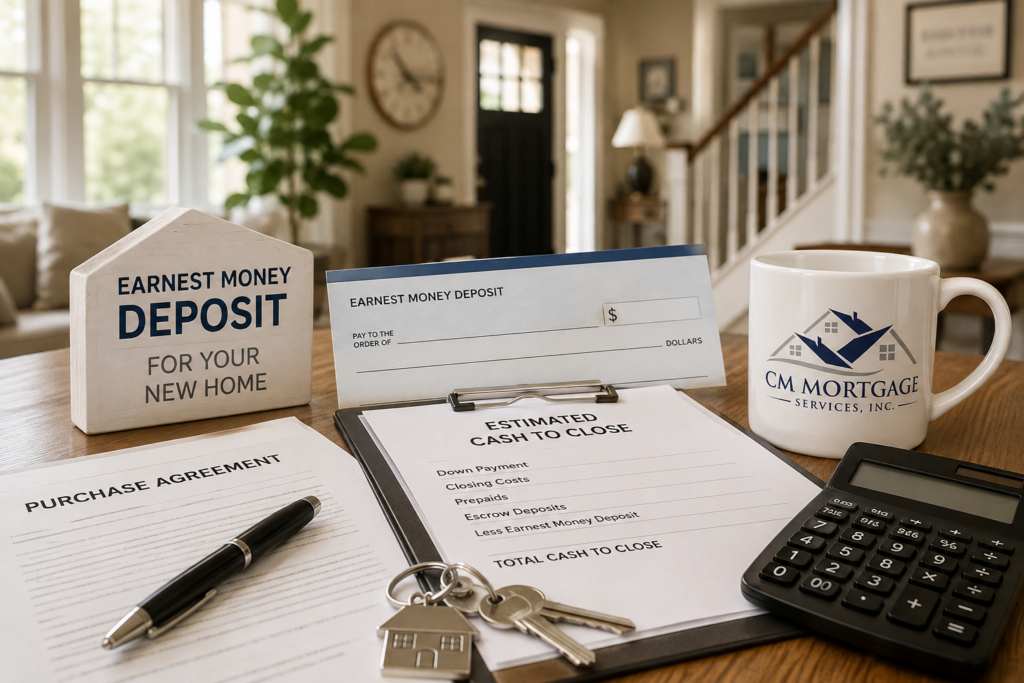
Earnest Money in Chester County PA: How Your Deposit Affects Your Mortgage and Cash to Close
Earnest Money in Chester County PA: How Your Deposit Affects Your Mortgage and Cash to Close
By J.R. Conway, NMLS #147631 | CM Mortgage Services Inc.
One of the questions I hear from first time buyers is:
“J.R., I already gave $10,000 with my offer. Is that on top of my down payment and closing costs?”
Usually, no.
Earnest money in Chester County PA is generally money you put toward the purchase when you enter into an Agreement of Sale. If the transaction goes to settlement, that deposit is normally credited back to you as part of the money you have already paid toward the transaction.
It does not simply disappear.
That sounds simple, but earnest money can create confusion for buyers because it happens early in the process. It may also need to be documented by the mortgage lender.
Where the deposit came from matters.
How it was transferred matters.
And if Mom or Dad provided the money, we may have an additional gift fund documentation issue.
I am J.R. Conway, owner and vice president of CM Mortgage Services Inc., a second generation, family owned mortgage brokerage located in West Chester, Pennsylvania. I have been helping homebuyers and homeowners navigate mortgage financing for more than 20 years, with a particular focus on Chester County and the surrounding communities. I personally guide my clients from the first conversation through settlement, helping them understand their financing options, monthly payment, cash needed to close, and the local factors that can affect a home purchase. NMLS #147631.
Earnest money is a good example of something that involves both the real estate contract and the mortgage.
Your real estate agent or attorney should answer questions about your rights under the Agreement of Sale.
My job is to make sure the mortgage lender can document the deposit and properly account for it when determining your cash needed at settlement.
What Is Earnest Money?
Earnest money is a deposit a buyer makes in connection with an accepted Agreement of Sale.
It shows that the buyer is putting money into the transaction.
The amount and timing are determined by the purchase contract. There is not one universal mortgage rule saying every Chester County buyer must provide the same amount.
One transaction may have a relatively modest deposit.
Another buyer may decide to offer a larger deposit as part of the terms of their offer.
That is a conversation to have with your real estate agent because the contract and the competitive situation matter.
From my side of the transaction, I want to know how much you are depositing and where that money is coming from.
Is Earnest Money an Extra Cost?
This is the biggest misunderstanding.
Suppose you are purchasing a home for $500,000.
You plan to make a 5 percent down payment.
That down payment would be:
$25,000
Now suppose your Agreement of Sale calls for a $10,000 earnest money deposit.
You do not normally add $10,000 to the $25,000 and suddenly have a $35,000 down payment requirement.
The $10,000 deposit is money you have already put into the transaction.
At settlement, it is normally reflected as a credit toward the funds you are required to bring.
Fannie Mae specifically recognizes the earnest money deposit on the sales contract as an acceptable source of funds for both the down payment and closing costs.
So if your total required down payment is $25,000 and $10,000 has already been deposited, you have already contributed part of the money needed for the transaction.
You still have closing costs, prepaid items, escrows, and any remaining down payment to consider.
That is why I look at the entire cash to close number instead of just the deposit.
My Closing Costs in Chester County PA article goes deeper into the other expenses buyers should plan for beyond the down payment.
A Simple Cash to Close Example
Let us stay with the $500,000 purchase.
Assume:
Purchase price: $500,000
5 percent down payment: $25,000
Earnest money already deposited: $10,000
Estimated closing costs and prepaid items: $22,000
Before accounting for the deposit, the buyer would have approximately $47,000 between the down payment and estimated costs.
But the buyer already put $10,000 into the transaction.
That means the remaining amount due would be approximately $37,000, assuming no other credits or adjustments.
The actual settlement figures will depend on the loan, property taxes, insurance, closing date, seller credits, and other items.
The important lesson is this:
Your earnest money deposit is normally part of your cash to close. It is not another expense sitting on top of it.
Why Does the Mortgage Lender Care About the Deposit?
Because I have to document your assets.
A mortgage lender cannot simply see $10,000 written on the Agreement of Sale and assume everything is fine.
We need to know that the deposit was actually made.
And in some situations, we need to verify where it came from.
Fannie Mae says receipt of the earnest money deposit can be verified with a copy of the borrower’s canceled check or a written statement from the holder of the deposit.
In a real loan file, I may ask you for the canceled check, evidence of an electronic transfer, your bank statement showing the money leaving your account, or documentation from the party holding the deposit.
Exactly what I need can depend on how the money was transferred and the underwriting findings for the loan.
This is one reason I tell buyers not to throw mortgage documents away after an offer is accepted.
Keep the paper trail.
I May Have to Source the Earnest Money
This is where the mortgage side gets more important.
Suppose you give a $15,000 deposit.
Your bank statements clearly show that you had $40,000 sitting in your checking and savings accounts before you made the deposit.
That is generally a straightforward story.
Now imagine you provide a $15,000 deposit, but before the deposit was made, your checking account only had $4,000.
Where did the other money come from?
Maybe you transferred it from another savings account.
Maybe you sold stock.
Maybe your parents gave it to you.
Maybe money was moved from an account we have not yet documented.
That does not automatically mean there is a problem.
It means I need to document the source.
Fannie Mae requires lenders to evaluate the source of funds used for the down payment and closing costs. Large deposits that are needed to complete a purchase also need to be documented from an acceptable source.
The earlier I know where the money came from, the easier that usually is.
Keep the Canceled Check or Transfer Information
This is a very practical piece of advice.
If you give an earnest money check, keep a copy.
When it clears your account, I may need evidence showing that it cleared.
If the deposit is sent electronically, save the transfer confirmation.
Do not assume your real estate agent, title company, mortgage company, and bank will automatically exchange every piece of documentation with each other.
Sometimes they will.
Sometimes they will not.
If I ask for proof of the deposit, having the documentation available can save us from chasing it later.
Fannie Mae’s guidance specifically says that if a canceled check is used to establish the source of the earnest money, the supporting bank statements need to cover the period through the date the check cleared.
That is why the canceled check and the corresponding account history can matter.
What If Mom or Dad Provides the Earnest Money?
This happens frequently.
A first time buyer finds a house sooner than expected.
They have enough income to qualify for the mortgage, but their parents are helping with some of the upfront money.
The parents may say:
“We will give you the $10,000 for the deposit.”
That may be perfectly workable.
But now we have two things to document.
We need to document the earnest money deposit.
We also need to document the gift.
This is where I want buyers to talk to me before the money starts moving.
Under current Fannie Mae guidelines, eligible gift funds can be used for a down payment and closing costs on qualifying transactions. The gift also needs to be documented, including a gift letter stating that no repayment is expected and evidence supporting the donor’s funds or transfer.
I recently wrote a full guide on using family gift funds for a mortgage in Chester County PA because this comes up so often with first time buyers.
If your parents are going to provide the earnest money, tell me first.
We can set up the paper trail correctly from the beginning instead of trying to reconstruct it afterward.
Do Not Use Untraceable Cash for Your Deposit
Cash creates unnecessary problems.
If Dad hands you $10,000 in cash and you deposit it into your checking account before writing the earnest money check, I now have to deal with a large cash deposit that may be difficult to document.
There is usually a cleaner way to handle it.
A properly documented check or electronic transfer creates a much better paper trail.
The same principle applies to the rest of your homebuying funds.
Do not start moving large amounts of money around without telling your loan officer.
Moving money between your own verified accounts is normally manageable.
Moving money between family members, depositing cash, opening new accounts, or suddenly receiving large deposits can require additional documentation.
Should You Put Down a Bigger Earnest Money Deposit to Make Your Offer Stronger?
This is where I stay in my lane.
A larger deposit may sometimes be part of a buyer’s offer strategy.
But whether you should offer a larger deposit is a real estate negotiation question.
Your real estate agent understands the property, the competing offers, and the terms of the Agreement of Sale.
I am looking at a different question:
Can you comfortably provide that deposit without creating a mortgage or cash flow problem?
Suppose you have $35,000 available.
Your agent discusses providing a $25,000 deposit as part of your offer.
Before doing that, I want you to understand where the rest of your closing funds are coming from.
You may still need money for your remaining down payment, closing costs, homeowners insurance, moving expenses, and reserves.
A stronger offer does not help much if you leave yourself without enough documented money to complete the transaction.
What Happens If the Purchase Does Not Close?
This is the section where I want to be careful.
Whether a buyer is entitled to receive an earnest money deposit back when a transaction does not close depends on the Agreement of Sale, contingencies, timing, circumstances, and applicable law.
That is not a decision the mortgage company makes.
For example, a financing contingency, inspection contingency, appraisal issue, termination deadline, or default may affect what happens.
But the exact rights of the buyer and seller are contract questions.
If a transaction is in danger of falling apart and you are concerned about your deposit, talk to your real estate agent and, when appropriate, a Pennsylvania real estate attorney.
I can explain what happened on the mortgage side.
I should not tell you who is legally entitled to the escrow deposit.
Pennsylvania regulates how real estate licensees handle deposits and escrow funds, including rules governing deposit handling and disputes.
Earnest Money Is Part of the Bigger Cash to Close Conversation
This is why I like buyers to understand the entire financial picture before they write an offer.
You may need a down payment.
You will have closing costs and prepaid items.
You may have inspection and appraisal expenses during the transaction.
And you may need to provide an earnest money deposit shortly after your offer is accepted.
Those numbers are connected.
My Closing Costs in Chester County PA article explains the expenses beyond your down payment, while my Gift Funds Mortgage Chester County PA guide explains how family assistance can be documented when parents are helping with the transaction.
For buyers who want the entire process in one place, my Chester County Home Buyer’s Guide walks through preparation, financing, offers, appraisals, closing costs, and settlement.
Frequently Asked Questions About Earnest Money in Chester County PA
Is earnest money the same thing as my down payment?
No. The earnest money deposit is money paid earlier in the purchase transaction. If the transaction closes, the deposit is normally credited toward the money you owe at settlement. Fannie Mae permits an earnest money deposit to be used toward the down payment and closing costs.
Is earnest money an additional closing cost?
No. It is not normally an additional fee. It is money you have already put into the purchase and is generally reflected as a credit when your final cash to close is calculated.
How much earnest money do I need in Chester County PA?
There is no single mortgage guideline requiring every buyer to provide the same earnest money amount. The deposit amount and deadlines are established through the Agreement of Sale. Discuss the offer strategy with your real estate agent.
Does my mortgage lender need proof that I paid the deposit?
Yes, the lender may need to verify that the earnest money was actually paid and, when applicable, verify its source. Fannie Mae allows receipt to be documented through a canceled check or written verification from the holder of the deposit.
Can my parents give me the money for my earnest money deposit?
Potentially, yes. When eligible gift funds are used, the gift and transfer need to be properly documented. I recommend talking to your loan officer before the funds are transferred.
What happens to my earnest money at settlement?
It is normally shown as money you have already contributed to the transaction and reduces the remaining cash you need to bring to closing.
Do I get my earnest money back if the deal falls apart?
It depends on the Agreement of Sale and the circumstances surrounding the termination. This is a contract question for your real estate agent or attorney rather than your mortgage lender.
Should I make a huge earnest money deposit to strengthen my offer?
That is an offer strategy decision to discuss with your real estate agent. From the mortgage side, I want to make sure the deposit does not leave you short of the verified funds needed for the rest of the transaction.
My Advice Before You Write the Check
Earnest money does not need to be complicated.
But I want you to understand where it fits.
If you are buying a home in Chester County, know how much money the Agreement of Sale requires and when it needs to be deposited.
Then make sure we can document where that money is coming from.
Save the canceled check or transfer information.
And if a parent or another eligible family member is helping with the deposit, tell me before the money moves.
The goal is not to create more paperwork.
The goal is to prevent a perfectly good deposit from creating a question during underwriting.
Your real estate agent handles the offer and the Agreement of Sale.
I handle the mortgage and make sure the money works when it is time to close.
J.R. Conway is the owner and vice president of CM Mortgage Services Inc., a second generation, family owned mortgage brokerage serving homebuyers and homeowners throughout Chester County and the surrounding communities. With more than 20 years of mortgage experience, J.R. personally guides clients from the first conversation through settlement. NMLS #147631.
To discuss your home purchase, cash to close, or mortgage preapproval, contact CM Mortgage Services Inc. at 610 430 6852 or start your secure mortgage application.
CM Mortgage Services Inc. | Company NMLS #143821
All loans subject to approval. Equal Housing Lender.


