How Your Credit Score and Income Actually Affect Your Mortgage Rate in Chester County PA
How Your Credit Score and Income Actually Affect Your Mortgage Rate in Chester County PA
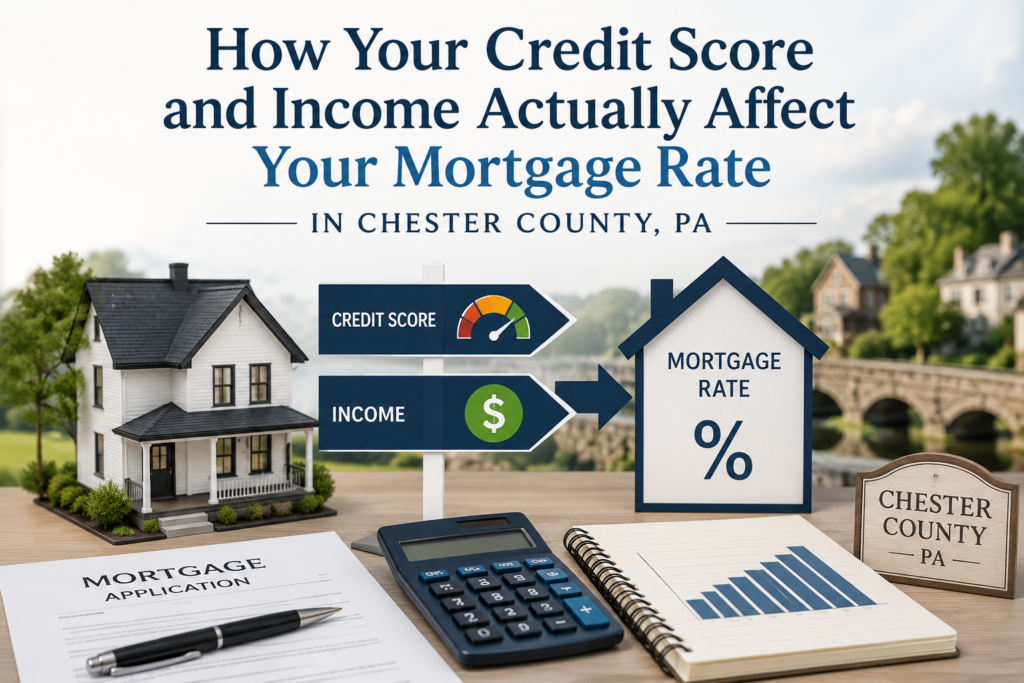
Most people think mortgage rates are something that happens to them. A number on the news, set by the Fed, the same for everyone shopping at the same time. That is not how it works, and not understanding the real mechanics costs Chester County buyers real money every single day.
Two buyers can walk into the same lender on the same morning, both looking at the same $500,000 Chester County home, and walk away with two different rates. Not because one negotiated better. Because of what is sitting underneath the rate quote: their credit score, their down payment, their income relative to Chester County’s median, and how their loan is structured.
I am J.R. Conway, owner and VP of CM Mortgage Services Inc., a second-generation, family-owned mortgage brokerage at 1240 West Chester Pike in West Chester. I have spent over 20 years showing Chester County buyers what is actually happening behind their rate quote, not just handing them a number. This guide walks through exactly how your credit score and income level change your rate, what to do about it before you apply, and a structuring strategy I use regularly that most buyers have never heard of.
Where Rates Actually Stand Right Now
As of mid-June 2026, the average 30-year fixed rate is running in the 6.47% to 6.6% range nationally, depending on which survey you look at. A rate under 6.50% on a 30-year term is considered a good one in today’s market. That is the starting point. But that average is a blended number across every credit score, every down payment, and every loan type in the market. It is not your rate. Your rate is determined by your specific file, and that is where most of this conversation actually matters. VISTA.Today
Loan Level Price Adjustments: The Part of Your Rate Nobody Explains
This is the mechanism that explains why two buyers with the same loan amount get different rates, and it is something most buyers have never heard of until I walk them through it.
Loan level price adjustments, or LLPAs, are fees that Fannie Mae and Freddie Mac charge based on a borrower’s credit score, down payment, and other risk factors. When greater risk is associated with the loan, such as a higher loan-to-value or a lower credit score, the LLPA is greater. These fees apply only to conventional loans. FHA, VA, USDA, and HUD Section 184 mortgages skip LLPAs entirely and use their own mortgage insurance or guarantee structures instead. CmmortgagePennsylvania Department of Transportation
Here is the part that surprises most buyers. The LLPA does not show up as a separate line item on your closing disclosure in most cases. It affects the price your lender gets when the loan is sold, and lenders typically convert that cost directly into your interest rate instead of charging it as an upfront fee. The conversion is roughly four to one. An LLPA of 0.50% will typically translate into a rate increase of approximately 0.125%. So when you see two rate quotes that differ by a quarter point or more, what you are usually seeing is the LLPA difference between two files, not two lenders pricing differently for no reason. CmmortgageCmmortgage
Credit score has one of the biggest impacts on your LLPA. Borrowers with scores of 740 or higher get the best pricing. Drop into the 720 to 739 range and the LLPA increases. The gap between credit tiers can be substantial. A borrower with a 750 score might pay 0.25% in LLPAs while someone with a 690 score on the identical loan could pay 2.0% or more. Run that through the four-to-one conversion and a swing from 750 to 690 can mean close to half a point difference in your actual rate on otherwise identical loans. Brandywine Battlefield
Loan-to-value also drives the LLPA. The pricing is not linear. The biggest reductions typically happen when you cross major thresholds, like moving from 75% LTV down to 70% LTV. That means a slightly larger down payment, even a few percentage points more, can produce a rate improvement that is larger than the math would suggest at first glance. Nextmovedelval
You may have seen headlines about Fannie Mae removing its 620 minimum credit score requirement in late 2025. Here is the practical reality on the ground as of 2026: that change exists on paper at the GSE level, but it has not translated into usable financing for most buyers below 620. Wholesale lenders have been slow to build pricing for scores under 620, automated underwriting systems are still not approving files below that line in practice, and the manual underwriting path that would be required instead is not something most lenders are doing right now. I am not going to tell a buyer their file qualifies because of a policy change if that policy is not actually being executed by the lenders I work with. The realistic floor for getting approved and priced today is still 620, and that is the number I plan around with every buyer.
What This Means If You Are Not a First Time Buyer Above 100% of Chester County’s Median Income
This is where Chester County’s specific numbers become important, and where I see buyers leave real money on the table because nobody explained the threshold to them.
Chester County’s 2026 Area Median Income is $122,700. For buyers whose qualifying income falls at or below that figure, Fannie Mae and Freddie Mac waive certain LLPAs entirely, regardless of credit score or loan-to-value within reason. That waiver does not exist for buyers above that threshold. If your household income exceeds $122,700, the full LLPA grid applies to your loan exactly as described above, in full force, based purely on your credit score and down payment.
This catches a specific kind of Chester County buyer off guard. A dual-income household, both partners working solid W2 jobs in the corporate corridor or in Philadelphia, combining for $140,000 or $150,000, is a completely normal Chester County profile. That household is above the AMI threshold and will pay the full LLPA grid. The buyer who assumes their strong income automatically gets them the best pricing is sometimes surprised that the LLPA hit lands hardest precisely because their income disqualifies them from the waiver that a lower-income buyer with the same credit score would receive.
The practical takeaway: for buyers above the $122,700 threshold, your credit score and down payment are doing all of the work in your rate. There is no income-based offset available to soften a 680 score or a 10% down payment. This is exactly why the credit score conversation matters more for Chester County’s typical buyer than it does in lower-cost markets, because so many Chester County households sit above the threshold where the program waivers apply.
Fannie Mae HomeReady and Freddie Mac Home Possible: The 80% AMI Threshold
One step below the 100% AMI waiver sits a separate and more powerful benefit available through HomeReady and Home Possible, the income-restricted conventional programs we covered in detail in our First-Time Home Buyer Chester County PA guide.
The qualifying income limit for both programs is 80% of Chester County’s Area Median Income, which is $98,160. Buyers under that threshold who use HomeReady or Home Possible get three real advantages over a standard conventional loan: reduced LLPA pricing built specifically into the program, meaningfully cheaper private mortgage insurance compared to standard conventional PMI at the same down payment level, and a 3% minimum down payment rather than the standard 5%.
The tradeoff is a required homebuyer education course. Both programs require completion of an approved course, typically a few hours done online, before closing. It is a small time investment relative to the savings the program delivers for a qualifying buyer.
The honest reality for Chester County: a meaningful share of buyers here, particularly dual-income households and buyers further along in their careers, will not fall under $98,160. For those buyers, the standard conventional path with 5% down is the right starting point, and the conversation shifts entirely to credit score and down payment strategy since the income-based program benefit simply is not available to them.
The Strategy I Use Regularly: Qualifying One Borrower, Adding the Other to Title
This is a structuring approach that comes up often in my files and that very few buyers know exists before I bring it up.
When two borrowers are purchasing together, typically spouses or partners, the loan does not have to be qualified using both incomes and both credit profiles combined. In many cases it makes more financial sense to qualify the loan using only one borrower’s income and credit score, while still adding both names to the title and the deed.
Here is why this matters for your rate specifically. When two borrowers apply jointly on a conventional loan, the LLPA pricing is generally based on the lower of the two credit scores, not an average and not the higher score. If one partner has a 760 score and the other has a 650, qualifying the loan jointly means the LLPA grid prices the loan as if both borrowers carry the 650 score. That can mean a significantly worse rate than necessary.
By qualifying the loan using only the borrower with the stronger credit profile, while both partners still go on title and the deed, the loan prices off the better score. The household still owns the home jointly. Both names are still on the property. But the rate reflects the stronger borrower’s credit, not the weaker one.
This strategy has real conditions and limitations. The qualifying borrower’s income alone needs to support the debt-to-income requirements for the loan amount. Not every couple can structure this way if the higher-credit-score partner does not have sufficient income on their own. But for the right file, particularly when one partner has excellent credit and solid income while the other has a lower score from an old issue that has not fully resolved, this approach can mean a meaningfully better rate than qualifying jointly would produce. It is exactly the kind of structuring conversation that a broker who knows your full file can identify, and it is not something most buyers think to ask about.
How This Connects to Your Credit Score Roadmap
If your score is currently sitting in the 620 to 680 range, the LLPA mechanics above are exactly why we wrote our guide on improving your credit score before buying in Chester County. The strategies in that guide, paying down credit utilization, negotiating pay-for-delete on collections, stopping active disputes before applying, are not just about qualifying for a loan. They are about which LLPA tier you land in, which directly becomes your interest rate through the four-to-one conversion described above.
A buyer who moves from 650 to 720 over six months of focused work is not just unlocking conventional eligibility. They are potentially moving themselves out of a high LLPA tier entirely, which can mean a rate improvement worth hundreds of dollars a month on a typical Chester County loan amount. That is real money, and it is entirely within a buyer’s control with enough lead time before applying.
What Actually Moves Your Rate, In Order of Impact
Based on the mechanics above, here is how I prioritize the conversation with Chester County buyers who want to improve their rate before applying.
Credit score is the single biggest lever for most buyers, particularly anyone below 740. The jump from 690 to 740 alone can represent a meaningful LLPA swing. Our credit improvement guide gives the specific roadmap for getting there.
Down payment and LTV thresholds matter more at certain breakpoints than others. Getting from 75% LTV to 70% LTV, or crossing 20% down to eliminate PMI entirely, often produces a bigger rate benefit than a marginal increase elsewhere.
Loan structuring, including the qualify-one-borrower strategy above, can produce a better rate without requiring months of credit repair, when the file supports it.
Program selection between HomeReady, Home Possible, standard conventional, FHA, and VA changes which pricing grid applies to you entirely, which is why this is always the first conversation in a pre-approval, before we even talk about a specific property.
Why This Conversation Needs to Happen Before You Shop, Not After
Chester County’s market moves fast. Homes in Downingtown, Exton, and Phoenixville go under contract in five to thirteen days. The buyer who finds out about their LLPA tier, their AMI eligibility, or a better loan structuring option after they are already under contract has lost the opportunity to fix it before the rate is locked.
This is the same principle behind every pre-approval conversation I have. Before you tour a single home, I want to know your full credit picture, your household income relative to Chester County’s thresholds, and whether there is a structuring strategy that gets you a better rate than the obvious path. For a full walkthrough of what that conversation covers, visit our Mortgage Pre-Approval Chester County PA guide.
Frequently Asked Questions About Mortgage Rates and Credit in Chester County PA
How much does my credit score actually affect my mortgage rate?
Significantly more than most buyers realize. Credit score drives loan level price adjustments on conventional loans, and the difference between a 690 score and a 750 score can mean an LLPA difference of close to 2 percentage points, which converts to roughly a 0.4 to 0.5 percentage point difference in your actual interest rate at the standard four-to-one conversion ratio. On a $500,000 loan that is hundreds of dollars per month.
What is the income limit to avoid loan level price adjustments in Chester County?
Buyers whose qualifying income falls at or below 100% of Chester County’s Area Median Income, which is $122,700 for 2026, receive certain LLPA waivers regardless of credit score. Buyers above that threshold pay the full LLPA grid based purely on credit score and down payment. A meaningful share of Chester County households, particularly dual-income families, fall above this threshold.
What is the income limit for Fannie Mae HomeReady and Freddie Mac Home Possible in Chester County?
The qualifying income limit for both programs is 80% of Chester County’s Area Median Income, which is $98,160. Buyers under that threshold get reduced LLPA pricing, cheaper mortgage insurance than standard conventional, and a 3% minimum down payment, in exchange for completing a required homebuyer education course.
Can one spouse qualify for a mortgage while both spouses go on the title?
Yes, in many cases. The loan can be structured so that only one borrower’s income and credit are used to qualify, while both partners are still added to the deed and title. This can produce a meaningfully better rate when one partner has a significantly stronger credit score than the other, since jointly qualified loans typically price off the lower of the two credit scores. The qualifying borrower’s income must independently support the loan’s debt-to-income requirements.
Do FHA and VA loans have loan level price adjustments?
No. LLPAs apply only to conventional loans backed by Fannie Mae and Freddie Mac. FHA, VA, and USDA loans use their own separate mortgage insurance and guarantee fee structures instead, which is a different cost mechanism entirely. This is one of several reasons the right loan program for a given buyer depends on more than just the interest rate quoted.
Is it better to wait for rates to drop before buying in Chester County?
For most buyers, no. Mortgage rates are currently in the mid 6% range and have been relatively stable through 2026. Waiting on the chance rates fall meaningfully ignores that Chester County home values are still appreciating and that homes in the most desirable communities are going under contract in days, not weeks. A buyer who improves their credit score and structures their loan well today can often achieve a better effective rate than waiting on a market-wide rate drop that may not materialize on a useful timeline.
Ready to Find Out What Your Actual Rate Looks Like?
J.R. Conway is the owner and VP of CM Mortgage Services Inc., a licensed, second-generation, family-owned, veteran-owned mortgage brokerage located at 1240 West Chester Pike, Suite 212, West Chester, PA 19382. NMLS #147631. CM Mortgage Services has been helping Chester County buyers understand exactly what drives their rate for over 20 years, offering Conventional, FHA, VA, USDA, Jumbo, DSCR, bank statement, and renovation loan programs.
If you want to know exactly where your credit score, income, and loan structure put you on the pricing grid before you start shopping for a home, that is the conversation I am ready to have. Start your application at cmmortgage.com or call us directly at 610-430-6852.
All loans subject to approval. Equal Housing Lender.


